Why the material matters
No glove protects against everything. The French occupational safety institute INRS points out that no material resists a chemical permanently, and that resistance depends on both the material and its thickness. A glove that is perfect for one task can be wrong for another, so start from the use, not from the catalogue.
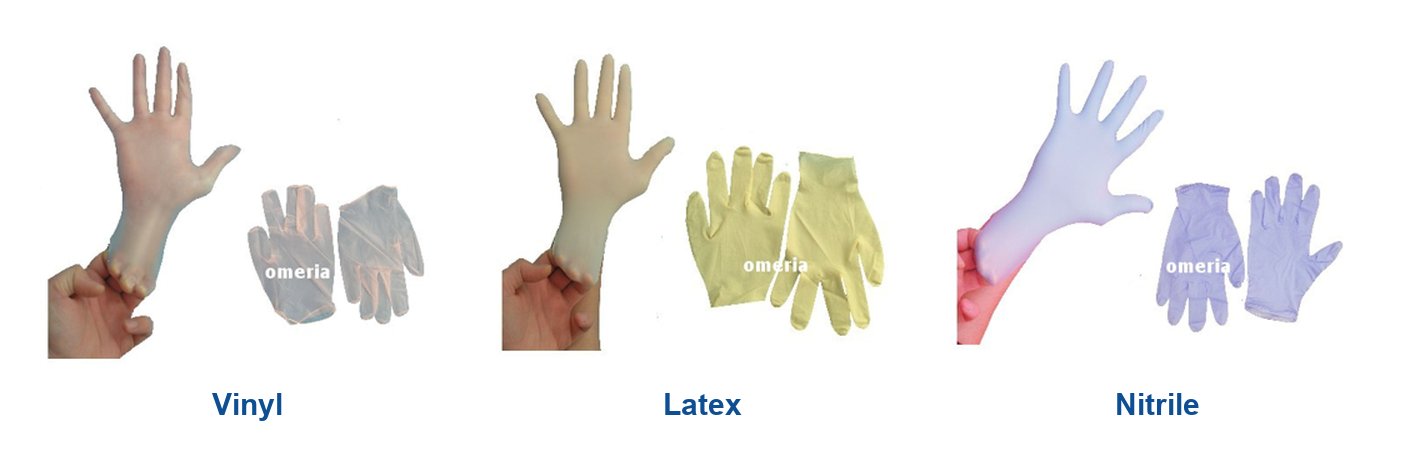
Nitrile, latex, vinyl: the differences
| Material | Strengths | Limits | Typical uses |
|---|---|---|---|
| Nitrile | Good puncture resistance, no latex proteins, most often tested for chemical protection | Slightly more expensive than vinyl | Medical, laboratory, industry, food |
| Latex | Very flexible and comfortable, good touch sensitivity | Latex proteins are the main cause of immediate rubber allergy | Medical, when no user is allergic |
| Vinyl | Lowest price | Less elastic, more permeable, shorter barrier life; often excluded for fatty foods | Short, low-exposure tasks, hygiene, service |
For users with a latex allergy, nitrile is the usual recommended substitute. Vinyl suits light, short tasks with no chemical exposure.
6 questions to ask
- What is the use: medical, food, chemical, cleaning or light handling?
- Are any users allergic to latex?
- Will the glove be in contact with chemicals? If so, which ones?
- Will it touch food, and fatty food in particular?
- How long will it be worn, and is fine touch sensitivity needed?
- What is the yearly volume and the budget per box?
Standards to check for each use
- Medical use: EN 455. For examination gloves, the required quality level (AQL) for the leak test is 1.5, which means at most 7 gloves with holes in a sample of 200.
- Chemical protection: EN ISO 374-1. Type A, B or C shows how many test chemicals the glove resists and for how long; Type A is the highest level. Compare the letters under the pictogram with the chemicals actually used.
- Food contact: Regulation (EC) 1935/2004. Ask for the food contact declaration and read its conditions of use (food types, temperature, duration).
- PPE status: under Regulation (EU) 2016/425, a Category II or III glove must be certified by a notified body, whose number appears on the certificate.
What matters in a bulk order
- Glove thickness and weight, written into the specification: two "nitrile" gloves can be very different.
- Sizes, packing (gloves per box, boxes per carton) and packaging markings.
- Shelf life and production date, especially for stock.
- Documents: certificate, EU declaration of conformity, test reports in the manufacturer's name and for the exact item.
- An approved sample before production, used as the reference afterwards.
Omeria's advice: Start from the use, not the price. A glove too light for the task ends up costing more: it tears, it is changed more often, or it simply cannot be sold for the intended use.
How Omeria helps
PPE is Omeria's original field. We help you define the right glove for your use, find factories able to make it and obtain the relevant documents, then we follow production according to your specification.
A sourcing project in Asia? We review your request free of charge.
Request a quote
Sources
- INRS (French occupational safety institute), Protective gloves fact sheet (FI 9): inrs.fr
- INRS, Latex protein allergy (TA 107): www.inrs.fr
- INRS, Protective gloves, ED 118: esst-inrs.fr
- INSPQ (Quebec public health institute), Infection prevention and control, personal protective equipment: www.inspq.qc.ca
- SATRA, EN 455 parts 1 to 4: satra.com
- Hartmann Science Center, Acceptable Quality Level (AQL): www.hartmann-science-center.com
- ATG Glove Solutions, EN ISO 374-1:2016: atg-glovesolutions.com
- ERIKS, EN 374 chemical, micro-organism and virus gloves: www.eriks.com
- Example of a supplier's food contact declaration for a vinyl glove: stadsing.dk
- Intertek, PPE Regulation 2016/425 guidance: intertek.com
- CTC, CE marking for PPE gloves: www.ctcgroupe.com